Etna’s Four Nights of Fire
A burst of activity in February 2021 turned the Southeast Crater into a lava fountain—and sent ash and lapilli across parts of eastern Sicily.
Etna’s February 2021 paroxysms were dramatic, but spectacle alone did not describe the hazard. Each episode unfolded over hours, while observatory staff tracked tremor, vent activity, lava, and ash dispersal.
The episode shows how an eruption can create different local effects at once: lava moving into an uninhabited valley and ash falling farther downwind.
See the event on the ground
Historical records show where effects were observed and what changed. These visuals are for context, not current hazard guidance.
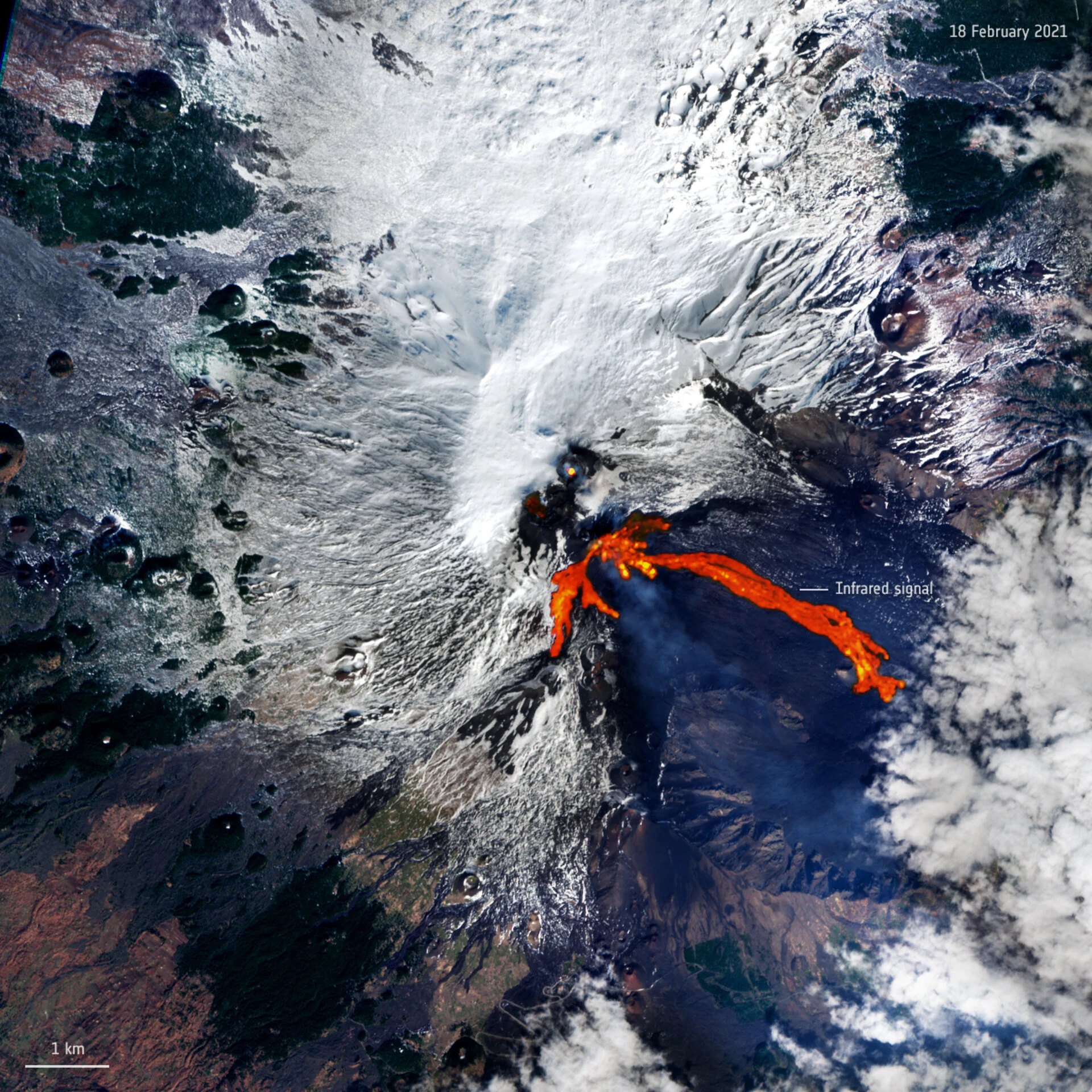
Sentinel-2 imagery from February 18, 2021, processed with shortwave infrared to make the lava flow visible. It shows flow paths, not a forecast of future activity.
Modified Copernicus Sentinel data (2021), processed by ESA ↗ · License details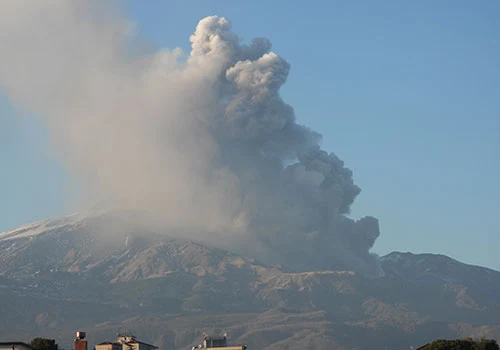
INGV documented ash and lava emissions during the episode from the ground and the observatory camera network.
Photograph: INGV / Osservatorio Etneo ↗ · License detailsHow the episode unfolded
First episode in the sequence
A lava fountain rose from the Southeast Crater. Lava spread toward the Valle del Bove, while ash and lapilli fell in areas to the south.
Activity repeats
New paroxysmal episodes followed over successive days. The observatory communicated changes as the activity evolved rather than treating each show as a long-term prediction.
The fourth episode intensifies
Strombolian activity grew into lava fountains, with jets reported up to 800–1,000 meters above the crater. An eruptive column rose at least 10 kilometers above the summit.
Fountain activity subsides
Explosive activity ended after 2 a.m. Lava flows continued advancing slowly without an active supply, according to INGV observations.
Fireworks are still a monitoring story
The bright fountain drew attention, but scientists interpreted it with multiple observations: volcanic tremor, visual surveillance, field inspections, lava-flow behavior, and ash reports. The timing and sequence helped distinguish a short-lived paroxysm from what followed.
Lava flowed toward the Valle del Bove, while ash and lapilli were carried downwind. Those hazards call for different monitoring and response information.
What one episode can—and cannot—say
Etna has a long and varied eruptive history. A cluster of paroxysms is useful context for understanding that volcano’s behavior, but it does not prescribe the timing or scale of a later episode.
For current information, consult INGV Osservatorio Etneo and civil-protection updates. A striking webcam image is not a substitute for official notices.
Read the source records
Key claims and dates are linked to their original publishers. Impact totals can vary by reporting date and method.